Finding the power of a number in log(n) time | Recursion
Given two integers 'a' and 'b', write a program to calculate the value of 'a' to the power 'b'(power(a,b)). For example if 'a' = 2 and 'b' = 3, then power(a,b) = power(2,3) = 8. If a = 2 and b = -3 then power(2, -3) = 1/8 = 0.125.
Expected time complexity is O(log(b)).
Video coming soon!
Subscribe for more updates
Algorithm/Insights
The algorithm is simple implementation of following recurrence relation used to calculate 'a' to the power 'b' where 'a' and 'b' are integers.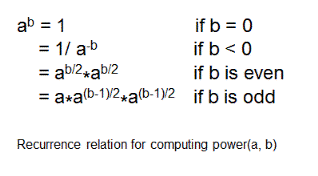
The generated recursion tree when above recurrence relation is implemented to calculate power(2,5) is shown below.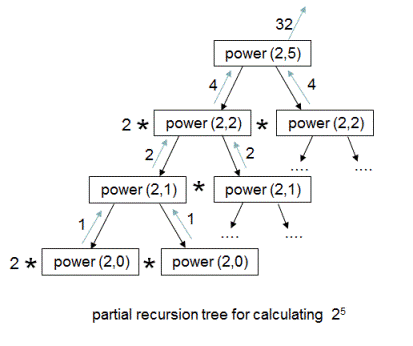
As you can observe, power(2,2,), power(2,1) are being computed multiple times. To avoid these redundant computations, we store the result in a temporary variable while making the recursive call and use this variable value sub-sequently. Please check 'public double power(int a, int b)' function in code snippet for implementation details.
The time complexity of this algorithm is O(log(b)) while computing power(a,b). This is because at every level in recursion sub-tree, we are doing only one computation(and using that value sub-sequently) and there are log(b) levels overall.
Please add comments below in case you have any feedback/queries.
Algorithm Visualization
Code Snippet
package com.ideserve.questions.nilesh;


/**
 * <b>IDeserve <br>
 * <a href="https://www.youtube.com/c/IDeserve">https://www.youtube.com/c/IDeserve</a>
 * Computes power of a number(power(a,b)) in log(b) time using recursion.
 * @author Nilesh
 */

public class PowerOfNumber
{
    // computes value of 'a' power 'b'
    public double power(int a, int b)
    {
        // base case
        if (b == 0)
        {
            return 1;
        }

        // a^(-b) = 1/(a^b)
        if (b < 0)
        {
            return 1/power(a,-b);
        }

        if (b%2 == 0) // if 'b' is even
        {
            return power(a, b/2)*power(a, b/2);
        }
        else // if 'b' is odd
        {
            return a*power(a, (b-1)/2)*power(a, (b-1)/2);
        }
    }

    public static void main(String[] args)
    {
        PowerOfNumber solution = new PowerOfNumber();

        int a = -2, b = -3;

        System.out.println(solution.power(a, b));
    }
}
Order of the Algorithm
Time Complexity is O(log(b)) while computing power(a,b)
Space Complexity is O(1)
Contribution
-
Sincere thanks from IDeserve community to Nilesh More for compiling current post.

Nilesh More