Postfix Expression Evaluation
Evaluate the value of a Postfix expression, also known as expression in Reverse Polish Notation.
Given: An array of strings, every string being either an operand or an operator, in Reverse Polish Notation, find out the value of the expression.
Assumptions: The given postfix expression will be a valid expression.
1. String operands will be valid Integers (positive or negative)
2. Operators will be valid operators in: + - / *
3. 0 will not be passed as a divisor for division operation.
Example:
Input:
20 30 +
Output:
50
Input:
5 1 2 + 4 * + 3 -
Output:
14
Note: Input is an array of strings to allow numbers with multiple digits as operands.
For example "20", "45" etc.
Video coming soon!
Subscribe for more updates
Algorithm/Insights
Reverse Polish notation (RPN) is a mathematical notation in which every operator is placed after its operands. For example, x + y (in infix notation) is expressed in RPN as x y +
It is also known as postfix notation.
The expression can be evaluated using a stack as described below:
1. If the array has only 1 element, then return the element.
2. Traverse the string array for elements i = 0 to length of array:
a. If the element at index i is an operand, then parse it to get the value.
b. Else, pop two elements from the stack (say x and y) and perform the operation specified by the operator (for example, +) on the 2 elements in the below order and store it as the value:
y = s.pop()
x = s.pop()
value = x + y
c. We will get a value from steps a OR b, push the value on to the stack.
3. Finally, only 1 integer element is left on the stack, return it.
Example:
String Array: 5 1 2 + 4 * + 3 -
1. Initialize empty stack.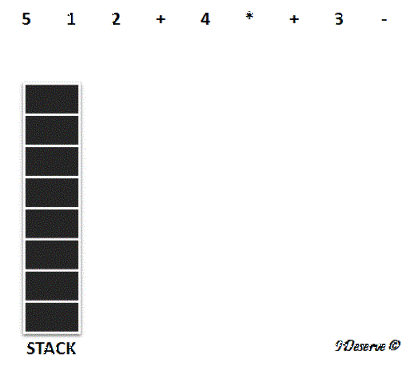
2. Since 5 is an operand, add it to the stack.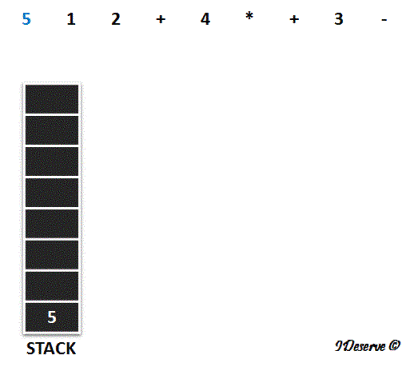
3. 1 and 2 are also operands, so add these to the stack too.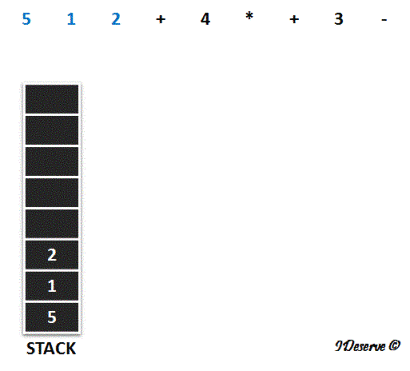
4. Next we have + operator,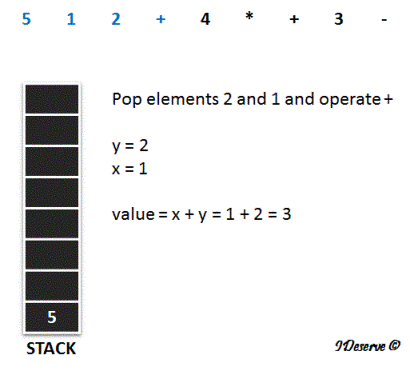
5. Push the value onto the stack.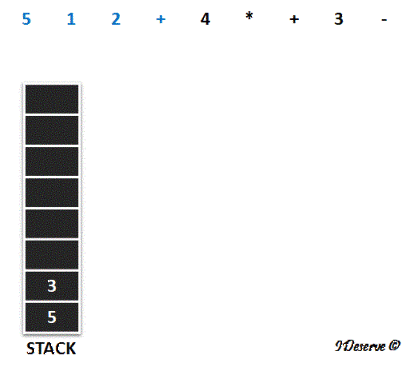
6. Next we have 4, which is an operand, so push it to the stack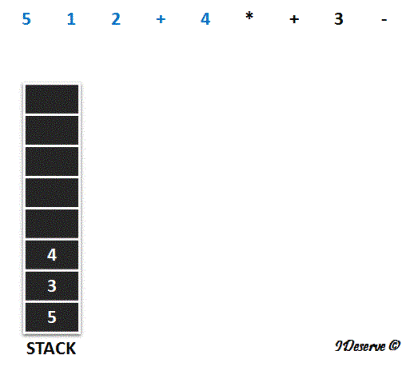
7. Next we have * operator,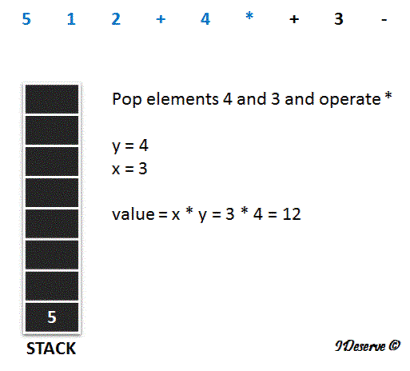
8. Push the value onto the stack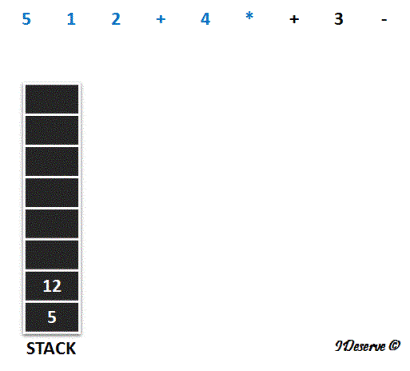
9. Next we have + operator,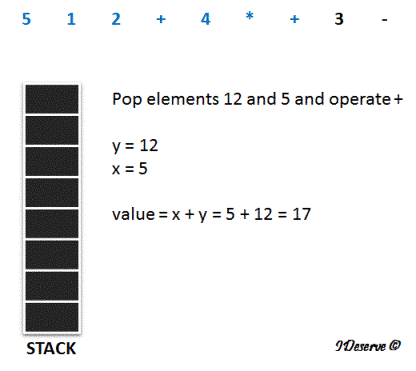
10. Push the value 17 onto the stack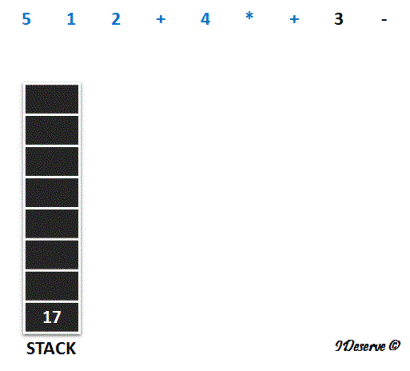
11. Next element is an operand 3, push it to the stack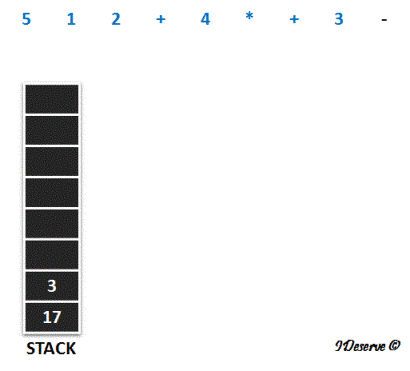
12. Last, we have - operator,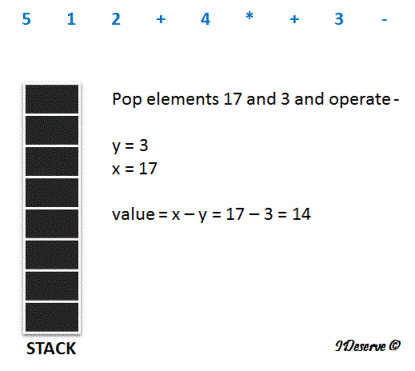
Finally, all the array elements are processed, and we have 14 as the result.
Algorithm Visualization
Code Snippet
package com.ideserve.questions.saurabh;

import java.util.Stack;

/**
 * <b>IDeserve <br>
 * <a href="https://www.youtube.com/c/IDeserve">https://www.youtube.com/c/IDeserve</a>
 * Given an array of Strings, every string being either an operand or an operator,
 * in Reverse Polish Notation, find out the value of the expression.
 *
 * @author Saurabh
 */
public class PostfixExpressionEvaluation {
    public static int evalPostfixExpression(String[] op) {

        if(op.length == 1) {
            return Integer.parseInt(op[0]);
        }

        Stack<Integer> s = new Stack<Integer>();
        for(String exp : op) {

            Integer value = null;
            String operator = null;
            if((exp.charAt(0) >= '0' && exp.charAt(0) <= '9') ||
               (exp.charAt(0) == '-' && exp.length() > 1)) {
                value = Integer.parseInt(exp);
            } else {
                operator = exp;
            }

            if(operator != null) {
                Integer y = s.pop();
                Integer x = s.pop();

                switch(operator) {
                    case "+" : value = x + y; break;
                    case "-" : value = x - y; break;
                    case "*" : value = x * y; break;
                    case "/" : value = x / y; break;
                }
            }
            s.push(value);
        }
        return s.pop();
    }

    public static void main(String[] args) {
        String[] op = {"5", "1", "2", "+", "4", "*", "+", "3", "-"};
        System.out.println("Value of the expression is " + evalPostfixExpression(op));
    }
}
Order of the Algorithm
Time Complexity is O(n)
Space Complexity is O(n)
Contribution
-
Sincere thanks from IDeserve community to Saurabh Kumar for compiling current post.

Saurabh Kumar