Check if a binary tree is sub-tree of another binary tree in space O(1)
Given two binary trees t1 and t2, check if tree t2 is sub-tree of tree t1. A sub-tree of tree T1 is a tree T2 having any one of the nodes 'n' and all the descendants of node 'n'.
In the following example, the middle tree - 'Tree_1' is sub-tree of leftmost tree - 'Tree_0'. Note that the rightmost tree - 'Tree_2' is not a sub-tree of 'Tree_0' because of the absence of node 8.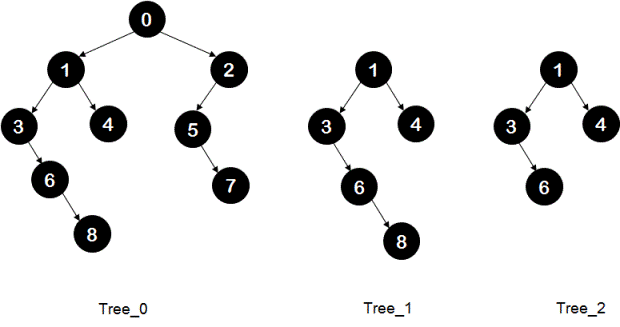
Video coming soon!
Subscribe for more updates
Algorithm/Insights
If function checkIfSubtree(TreeNode bigTreeRoot, TreeNode smallTreeRoot) implements this algorithm then the steps of this intuitive algorithm are as following -
1. If 'smallTreeRoot is equal to null' then return true since 'null' tree is sub-tree for any tree.
2. If condition #1 is not true then check if 'bigTreeRoot is equal to null'. If it is then return false since null tree cannot have any sub-tree except null tree for which we have already checked in #1.
3. If both conditions #1 and #2 are not true then check if value of smallTreeRoot is equal to value of bigTreeRoot.
4. If condition #3 evaluated to true then we check if left sub-tree of smallTreeRoot exactly matches to left sub-tree of bigTreeRoot and right sub-tree of smallTreeRoot exactly matches to right sub-tree of bigTreeRoot. If both sub-trees match then we return true since we know that smallTree is now a sub-tree of bigTree.
5. If either #3 or #4 evaluate to false then we check if left sub-tree of bigTreeRoot contains smallTree or right sub-tree of bigTreeRoot contains smallTree. For checking this we simply make recursive calls.
Time complexity for this approach is O(n^2) and space complexity for this approach is O(1).
Algorithm Visualization
Code Snippet
package com.ideserve.questions.nilesh;

/**
 * <b>IDeserve <br>
 * <a href="https://www.youtube.com/c/IDeserve">https://www.youtube.com/c/IDeserve</a>
 * Check if tree 't2' is sub-tree of tree 't1'
 * @author Nilesh
 */
public class CheckIfSubtree {

    class TreeNode
    {
        TreeNode left;
        TreeNode right;
        char key;

        public TreeNode(char key)
        {
            this.key = key;
        }
    }

    TreeNode root;

    /*
                            0
                      1             2
                  3      4       5
                    6              7
                      8
    */

    private TreeNode createBigTree()
    {
        TreeNode n0 = new TreeNode('0');
        TreeNode n1   = new TreeNode('1');
        TreeNode n2   = new TreeNode('2');
        TreeNode n3   = new TreeNode('3');
        TreeNode n4   = new TreeNode('4');
        TreeNode n5   = new TreeNode('5');
        TreeNode n6   = new TreeNode('6');
        TreeNode n7   = new TreeNode('7');
        TreeNode n8   = new TreeNode('8');

        n0.left  = n1;
        n0.right = n2;

        n1.left  = n3;
        n1.right = n4;

        n2.left  = n5;

        n3.right = n6;

        n5.right = n7;

        n6.right = n8;

        root = n0;
        return n0;
    }


    /*
                      1
                  3      4
                    6
                      8
    */
    private TreeNode createSmallTree()
    {
        TreeNode n1   = new TreeNode('1');
        TreeNode n3   = new TreeNode('3');
        TreeNode n4   = new TreeNode('4');
        TreeNode n6   = new TreeNode('6');
        TreeNode n8   = new TreeNode('8');

        n1.left  = n3;
        n1.right = n4;

        n3.right = n6;

        n6.right = n8;

        root = n1;
        return n1;
    }


    private boolean completeMatch(TreeNode bigTreeRoot, TreeNode smallTreeRoot)
    {
        if ((bigTreeRoot == null) && (smallTreeRoot == null))
        {
            return true;
        }

        if ((bigTreeRoot == null) || (smallTreeRoot == null))
        {
            return false;
        }

        if (bigTreeRoot.key == smallTreeRoot.key)
        {
            return completeMatch(bigTreeRoot.left, smallTreeRoot.left) && completeMatch(bigTreeRoot.right, smallTreeRoot.right);
        }

        return false;
    }


    public boolean checkIfSubtree(TreeNode bigTreeRoot, TreeNode smallTreeRoot)
    {
        if (smallTreeRoot == null)
        {
            return true;
        }
        if (bigTreeRoot == null)
        {
            return false;
        }

        if (bigTreeRoot.key == smallTreeRoot.key)
        {
            if (completeMatch(bigTreeRoot, smallTreeRoot))
            {
                return true;
            }
        }

        return checkIfSubtree(bigTreeRoot.left, smallTreeRoot) || checkIfSubtree(bigTreeRoot.right, smallTreeRoot);
    }

    public static void main(String[] args)
    {
        /*
                                0
                          1             2
                      3      4       5
                        6              7
                          8
        */
        CheckIfSubtree bigTree = new CheckIfSubtree();
        bigTree.createBigTree();


        /*
                          1
                      3      4
                        6
                          8
        */
        CheckIfSubtree smallTree = new CheckIfSubtree();
        smallTree.createSmallTree();

        System.out.println("If small tree is sub-tree of big tree: " + bigTree.checkIfSubtree(bigTree.root, smallTree.root));
    }
}
Order of the Algorithm
Time Complexity is O(n^2)
Space Complexity is O(1)
Contribution
-
Sincere thanks from IDeserve community to Nilesh More for compiling current post.

Nilesh More